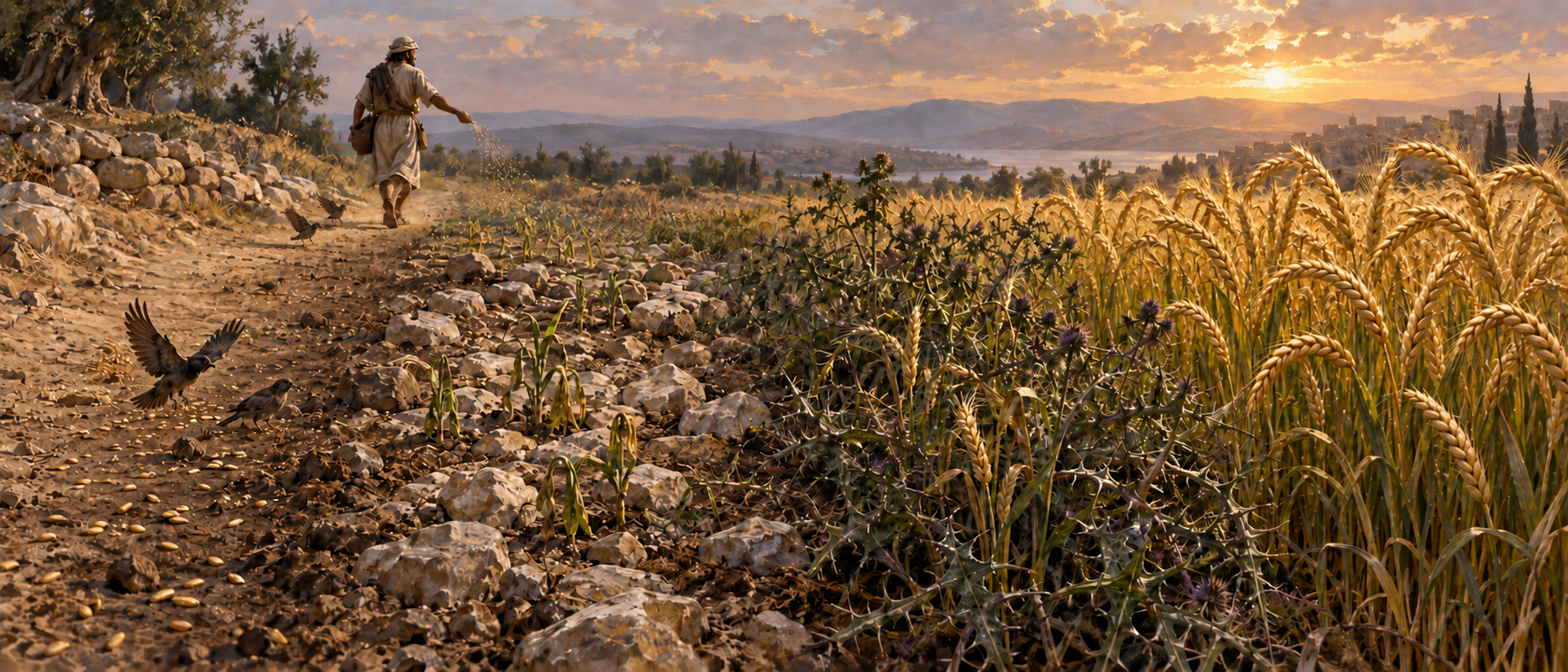
What the four soils show us
In Jesus’ explanation, the seed is the word of God, and the soils show different responses to it. The path represents those who hear without understanding; rocky ground represents those who receive the word with joy but have no root and fall away when trouble or persecution comes; thorns represent those choked by the cares of the world and the deceitfulness of riches; and good soil represents those who hear, understand, and bear fruit.
When following Jesus becomes costly, the parable invites each of us to ask: “Which seed am I?” Notice how the seeds can't control what soil they are dropped on. Some environments are much more difficult than others for being a Christian. But who do I want to be? Jesus tells us ahead of time what can happen when people hear his word: some fall away when trouble comes, while others endure and bear fruit. Knowing that, what kind of hearer will I choose to be? Perhaps not every seed in each of these soils fell apart and was undone, but he is giving you an idea of how the typical pattern happens to people in different environments and why they usually give up their faith in him.
Jesus tells people to count the cost
If it is hard to remain a Christian, you are not imagining the cost. Following Jesus can bring pressure, loss, misunderstanding, and fear. Jesus never promised that discipleship would be easy. But hardship and fear do not mean that Jesus has forgotten you or that you must face this alone.
When great crowds were traveling with him, Jesus spoke plainly about what it means to follow him. He compared discipleship to building a tower: a person should first “count the cost” (Luke 14:25–33). Jesus was not trying to trick people into following. He was making clear that he must come before every other loyalty.
Luke also records three people who expressed a desire to follow Jesus but hesitated when they considered what it would mean (Luke 9:57–62). These passages are searching, but they are not meant to make a frightened or suffering person conclude that they are beyond hope. They show that following Jesus calls for a whole-hearted allegiance.
Jesus said that those who follow him must take up their cross. He also asked, “For what does it profit a man to gain the whole world and forfeit his soul?” (Mark 8:34–38; see also Matthew 16:24–28 and Luke 9:23–26). That is a serious question about what lasts—not a claim that fear, grief, or seeking safety makes you faithless.
Why keep following Jesus?
First, look at what Jesus has done. Christian hope does not rest on our being strong enough to earn God’s love. It rests on God’s love for us: “while we were still sinners, Christ died for us” (Romans 5:8).
Jesus also gave his disciples a promise about their future with him. He told them that he was going to prepare a place for them, and promised, “I will come again and will take you to myself” (John 14:1–3). This is not a promise that life now will be painless or that every earthly desire will be fulfilled. It is the promise that Jesus will receive his people to himself.
Jesus speaks about lasting treasure and “true riches” (Matthew 6:19–21; Luke 16:10–12). We may not be able to picture everything God has promised, but we can trust the one who made the promise. Our lives here are brief. James says that life is “a mist that appears for a little time and then vanishes” (James 4:14). That does not make today’s pain unimportant; it reminds us that today’s suffering is not the whole story.
The Bible does not pretend that evil is unreal or that justice has already been done. It points toward the day when God will make all things new: “death shall be no more” (Revelation 21:1–5). Christian hope is not that everything will be made right immediately, but that suffering and death will not have the final word.
Take the next faithful step
In Matthew 10:23, he tells his disciples that when they are persecuted in one town, they may flee to another. Take wise steps to protect yourself and those in your care. Seeking safety is not automatically a denial of faith.
If you are wondering how you can keep going, you do not have to solve your whole future today. Seek the help and companionship of trustworthy Christians. Bring your fear, grief, and questions to God. Hold on to Jesus one step at a time. Neither hardship nor death gets the final word in the story he has promised.
Working draft for review. Scripture quotations are from the ESV® Bible (The Holy Bible, English Standard Version®), © 2001 by Crossway, a publishing ministry of Good News Publishers. ESV Text Edition: 2025. Used by permission. All rights reserved.